

Jack’s View
From paperwork to a plan.
Red Barn Software's own product, at jacksview.com. A home record with an AI named Jack on top of it, built for homeowners, realtors and anyone who has to prove something about a house.
Live — web, iOS and AndroidDrop in a closing packet, an inspection report or a photographed receipt. Jack works out what it is, files it, and pulls the make, model and install date off your equipment.
What a buyer's agent will actually ask for, sourced from NAR and state seller-disclosure requirements. The report scores the house and lists what's missing.
From when the water heater was last serviced to who did the roof, answered from the record rather than from memory.
Reconciled from InterNACHI and NAHB, which disagree with each other. So how long a roof lasts has one answer here, not three.
- Services
- Product strategy · Custom web platform · Native iOS and Android apps · Document intelligence · Conversational AI
- Engagement
- Our own product. We are the client, which means every shortcut we didn't take was a choice we made with our own time.
- Timeline
- First commit July 2025 · thirteen months of continuous development · live on web, iOS and Android
- Built with
- Ruby on Rails · PostgreSQL · Hotwire · React Native · Claude and OpenAI · Stripe
The problem
Homes don't come with service records.
Buy a used car and you can pull its history. Buy a house and you're guessing. How old is the furnace. Was the roof ever inspected. Who fixed the plumbing, three owners ago, and did they do it properly.
The paperwork exists. It's in a drawer, an email thread, a photo roll, and a folder of closing documents nobody has opened since the day they signed them. So the obvious answer is a place to file it all — and that answer has been tried, over and over. It fails on discipline. Filing is work with no payoff today, so nobody keeps it up.
Which leaves the real problem, and it isn't a technical one. The days a home record is worth real money — an insurance quote, a claim, a refinance, a listing — are rare, and years away. Nobody does years of unrewarded filing to be ready for a day that might not come.
A house has its own vocabulary
Getting it wrong is how these products fail. Every term below is one the system had to understand before it could file a single thing correctly:
Our approach
Jack's View is a record of a house with an AI named Jack sitting on top of it. A journal of what's happened. An inventory of the equipment, down to the make and the serial number. The documents themselves. And the plumber, the electrician and the roofer who did the work.
It's named for Giacomo “Jack” Millefolie, our founder's father — a Sicilian immigrant and a craftsman who did his own woodworking, plumbing, electrical and masonry. He was the one in the family who knew what had been done to a house, and when. That's the job the software has.
Two decisions shaped the rest.
Make it almost no work to put things in
Instead of a form, a place to drop things. Photograph a receipt. Drag in an inspection PDF. Forward an email to the house's own address. Jack reads it, works out what it is, and comes back with where each piece belongs — a journal entry for what happened, the document filed, the contractor added to your Home Team, the water heater's make and model lifted off the receipt.
The inspection report is the one that changes people's minds. Thirty to a hundred pages, read once on the day you bought the house and never again. Drop it in and Jack comes back with the equipment it found, the contractors it names, and every repair the inspector told you to make — as a list you can actually work through. One drop turns a document into a plan.
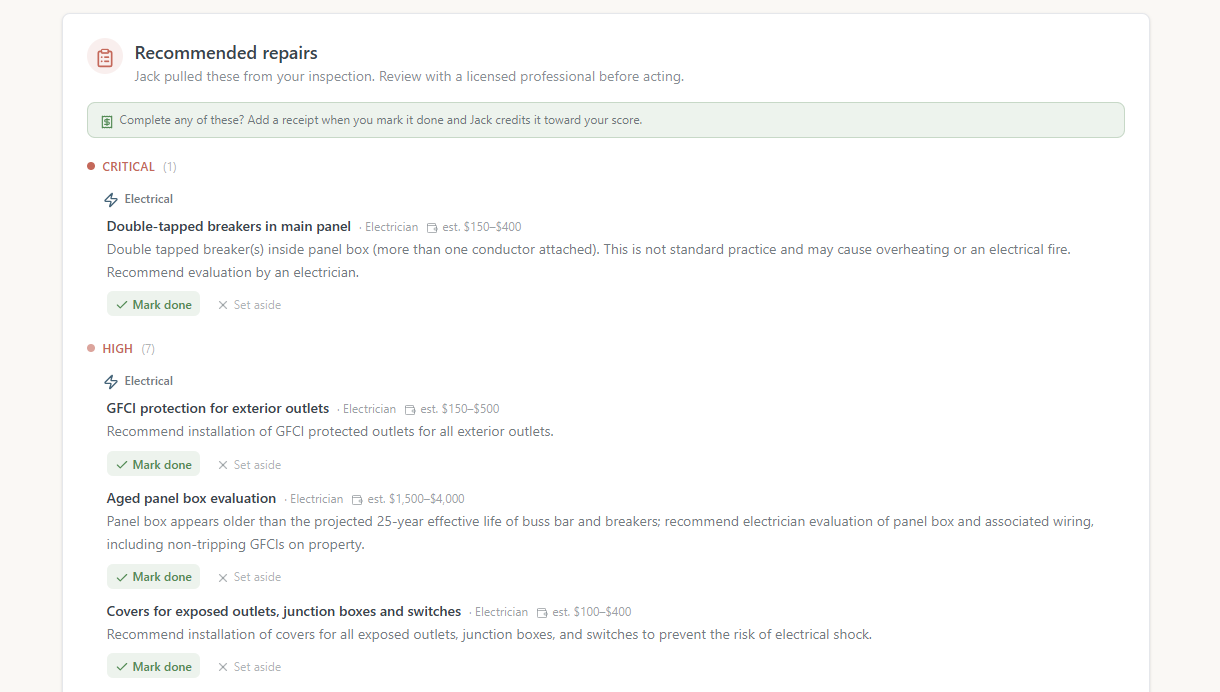
Nothing is written until you say so. The old form is still there if you want it, but it's no longer the way in.
Give people a reason to bother today
A complete record is worth a great deal on four or five days in a home's life. So the product builds the things people want on those days, and lets the record fill up behind them.
- Selling. A sale-readiness report scored against sixteen items — drawn from the National Association of Realtors, insurers, and state seller-disclosure requirements — that tells you what a buyer's agent is going to ask for and which of it you don't have yet. Every gap is fixable from the page it's listed on.
- Insuring. A report built for the quoting conversation: the ages, makes and service history an agent needs to price a policy, in one document instead of recalled down the phone.
- Claiming. The same record from the other direction. What was there, when it was serviced, who did the work, and the receipt.
- Owning. Jack's Score — a rating out of a hundred for how well a house is documented and looked after, built from evidence rather than from what you say about yourself.
All of it on the web and in native iOS and Android apps, because receipts get photographed standing in a basement, not sitting at a desk.
Jack proposes. You decide.
Jack reads the documents and drafts the entries. He doesn't get the last word on any of them, and that boundary was drawn before we shipped rather than after an incident.
It's the difference that matters most in a product like this, because a home record that guesses is worse than one that's empty. The whole value is being able to trust it in a year, when you can't remember what you put in.
Four things you only know if you've lived it
- A quote is not a completed job. Most systems would credit both documents on the same repair. But a quote proves a conversation and an invoice proves the work — so a quote earns nothing until an invoice confirms it, and then it steps aside permanently, so the same job can never count twice.
- A general contractor isn't a trade. Neither is a handyman, or a window installer. Ask any of them what they do and you'll get a sentence, not a category — so the system leaves those unmapped instead of guessing, with a manual override for the times somebody knows better.
- The experts disagree about how long a roof lasts. InterNACHI and NAHB don't match, and three parts of the product had each quietly picked a different number. We consolidated them into one table without changing a single value, checked it against a known-good score, and only then reconciled the differences — so that fixing the data couldn't silently move everybody's rating overnight.
- A lapsed subscription still reads and exports. Your documents stay yours to open and to take with you. Holding a homeowner's own paperwork hostage to get them to renew was never going to be the business we're in.
The outcome
Jack's View is live on the web and in both app stores.
The record fills itself from paperwork you already own, and the days that used to mean a scramble each have a document behind them now: what a buyer's agent will ask for, what an insurance agent needs to quote, what an adjuster wants to see, and what the next owner of the house ought to be told.
It's also the plainest thing we can show you about how we work. There was no client here to push back on a shortcut and no budget conversation to force the question. Every decision above — refusing to guess a trade, letting a score stay honest about what it doesn't know, reconciling two published sources by hand before trusting either — cost time that nobody was ever going to make us spend.
That's the standard. It doesn't change when someone else is paying for it.

Running the same problem?
Tell us how it works today. We'll tell you honestly whether software is the answer.
[email protected]